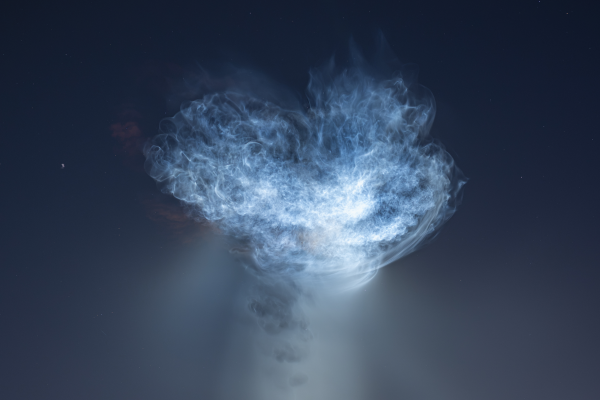
A glowing shape spread across the early morning sky, looking more like an ocean creature than a rocket trail. The SpaceX launch jellyfish gave observers across the eastern United States an extraordinary reason to look up on October 13, 2026.
Behind the spectacle was a Falcon 9 rocket carrying a Dragon spacecraft toward the International Space Station. Its illuminated exhaust created the sweeping outline that earned the phenomenon its memorable nickname. Understanding the display starts with a surprisingly simple combination: rocket exhaust, sunlight, and a dark sky.
What Causes the SpaceX Launch Jellyfish?
The jellyfish appearance happens when sunlight illuminates a rocket’s exhaust plume near sunrise or sunset. People on the ground can still be surrounded by darkness while the rising rocket reaches sunlight.
That difference makes the plume stand out dramatically. Rather than seeing only a bright point moving overhead, observers may notice a broad, luminous cloud stretching behind it.
For a closer look at this extraordinary meeting of sunlight and spaceflight, NASA’s space jellyfish explanation reveals how an ordinary exhaust trail becomes a glowing sky spectacle.
Which SpaceX Mission Created the Display?
The October 13 launch was SpaceX CRS-35, NASA’s 35th commercial resupply mission with the company. Falcon 9 lifted off at 6:33 a.m. EDT from Cape Canaveral Space Force Station in Florida.
Dragon carried more than 6,300 pounds of supplies and hardware. Its cargo included scientific experiments and the final pair of International Space Station Roll-Out Solar Arrays.
Those solar arrays support an important practical goal: increasing available electricity aboard the orbiting laboratory. The mission also transported research involving artificial retinas, heart tissue models, and brain organoids. Behind the striking photographs was a delivery supporting ongoing scientific work.
Curious about technology closer to home? Explore the Apple HomeView price, features, and release date in our detailed guide.
Why Did the Cloud Look So Unusual?
A rocket launch changes appearance throughout its climb. During this mission, the expanding plume caught the rising sunlight as Falcon 9’s stages separated.
NASA highlighted a timelapse recorded from Indian Harbour Beach, Florida, showing the launch unfolding against the predawn sky. The footage captured the growing jellyfish plume, the continuing journey toward orbit, and the booster’s return.
The cloud remained visible even after the first stage landed. That lingering shape helps explain why photographs can resemble something suspended overhead rather than a conventional rocket streak.
Can Another Launch Produce the Same Effect?
Yes, but launching a rocket does not automatically create a space jellyfish cloud. Sunrise or sunset timing is central to the illuminated appearance.
For anyone hoping to watch, a useful starting point is checking the confirmed mission schedule and local viewing conditions. Choose an open viewpoint and identify the expected launch direction beforehand.
Keep expectations realistic: photographs from another location cannot guarantee the same view from your neighborhood. The October display offers a compelling reminder that spaceflight sometimes becomes visible far beyond the launchpad. A routine glance outside can reveal the connection between sunlight, Earth’s atmosphere, and a spacecraft beginning its journey into orbit.
For a different kind of spectacle, discover how the Fourth Wing Prime Video adaptation is bringing its dragon-filled fantasy world to the screen.
Frequently Asked Questions
1. What is the SpaceX launch jellyfish?
It is a jellyfish-shaped glow created when sunlight illuminates rocket exhaust high above observers during a launch near sunrise or sunset.
2. When did the October 2026 space jellyfish appear?
The display followed the October 13, 2026, Falcon 9 launch at 6:33 a.m. EDT from Cape Canaveral Space Force Station, Florida.
3. Was the glowing cloud caused by a rocket explosion?
NASA identified the photographed glow as sunlight illuminating the rocket’s exhaust plume. The unusual shape itself was not evidence of an explosion.
4. Was this a Starlink launch?
No. This display accompanied SpaceX CRS-35, a Dragon cargo mission delivering scientific experiments, supplies, and equipment to the International Space Station.
5. Does every Falcon 9 launch create a jellyfish cloud?
No. The illuminated effect depends on lighting conditions, particularly launches near sunrise or sunset, when high-altitude exhaust can catch sunlight against darker skies.