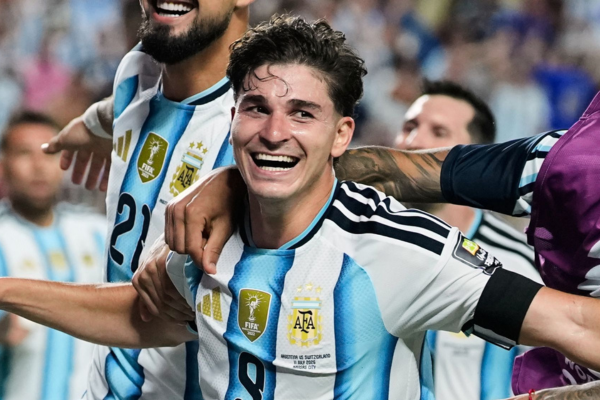
Argentina’s 3-1 victory over Switzerland was far less comfortable than the final score suggests. The defending champions needed extra time, tactical patience and decisive contributions from their attacking substitutes to overcome a Swiss side that challenged them physically and strategically.
The Argentina vs Switzerland quarterfinal became a test of endurance rather than a display of complete dominance. Lionel Scaloni’s team controlled important phases, but Switzerland’s compact structure, aggressive pressing and direct attacking transitions prevented Argentina from establishing their usual rhythm.
Argentina Strike Early but Fail to Take Control
Argentina gained the advantage through Alexis Mac Allister, who converted after Lionel Messi created the opportunity from a set piece. The early goal should have allowed the champions to dictate the tempo, yet Switzerland responded with confidence instead of retreating.
Murat Yakin’s side pressed Argentina’s midfield, competed strongly for second balls and attacked quickly whenever possession changed hands. Their approach limited the influence of Argentina’s central creators and forced Scaloni’s defenders to make uncomfortable decisions under pressure.
Switzerland’s persistence was rewarded when Dan Ndoye equalised, turning the contest into a genuine quarterfinal battle. The goal reflected Argentina’s difficulty in protecting transitional spaces after losing possession.
Morocco vs Canada showcased the Atlas Lions at their clinical best, as a dominant performance secured a convincing victory and a well-earned place in the FIFA World Cup quarterfinals.
Embolo Red Card Changes the Tactical Balance
The most controversial moment arrived when Breel Embolo received a second yellow card for simulation. Switzerland were reduced to ten players shortly after drawing level, although their organisation remained impressive.
Yakin’s team dropped into a deeper defensive block, protected central areas and attempted to push the match toward penalties. Reuters reported that the Swiss coach later criticised the rule behind Embolo’s dismissal, particularly because the decision had a major influence on the match’s direction.
Argentina responded by increasing their attacking numbers, but their possession occasionally became predictable. Messi continued to create space and draw defenders, yet Switzerland’s narrow defensive shape prevented clear opportunities during normal time.
Julián Álvarez Delivers the Defining Moment
Extra time finally opened the spaces Argentina had struggled to find. Julián Álvarez produced the decisive breakthrough with a powerful finish that changed the emotional and tactical balance of the contest.
The goal rewarded Argentina’s persistence and demonstrated the importance of their attacking depth. Scaloni could introduce players capable of increasing the tempo against tired defenders, while Switzerland had fewer options after playing with ten men.
Lautaro Martínez later added Argentina’s third goal, completing a 3-1 victory that looked convincing on paper but had required considerable patience. Sky Sports confirmed that Mac Allister, Álvarez and Martínez scored the goals that secured Argentina’s semifinal place.
Switzerland Leave with Pride Despite Elimination
Switzerland’s campaign should not be judged solely by the defeat. They reached the World Cup quarterfinals, eliminated Colombia on penalties and pushed the reigning champions into extra time.
Their performance against Argentina showed discipline, tactical intelligence and courage. Even after losing Embolo, they remained organised and forced Argentina to search for solutions rather than simply waiting for mistakes.
Reuters reported that frustration over the refereeing decisions was balanced by pride in Switzerland’s top-eight finish. That reaction accurately reflects a campaign that strengthened their reputation despite ending in disappointment.
America 250 marks a historic milestone as the United States celebrates its 250th birthday on Independence Day 2026—read more about the nationwide events, traditions and meaning behind the anniversary.
Argentina vs Switzerland Victory Sets Up a Historic Semifinal
The Argentina vs Switzerland result sends Scaloni’s team into a blockbuster semifinal against England. Argentina will enter that match with confidence, but this performance also revealed vulnerabilities.
Their midfield can be disrupted by aggressive pressure, and their defensive transitions remain an area opponents may target. England possess the physical strength and attacking quality to exploit those moments.
However, Argentina once again demonstrated why they remain serious title contenders. They stayed composed, used their squad intelligently and found decisive quality when the match became most demanding.
The victory was not Argentina’s most polished performance, but knockout tournaments are rarely won through perfection alone. Their ability to survive pressure, adapt tactically and deliver in extra time may ultimately prove more important than dominance.
For a detailed breakdown of Argentina vs Switzerland, FIFA’s official match report highlights how the defending champions overcame a resilient Swiss side to book their place in the World Cup semifinals.
FAQs
1. Who won Argentina vs Switzerland?
Argentina defeated Switzerland 3-1 after extra time in the FIFA World Cup 2026 quarterfinal.
2. Who scored Argentina’s goals against Switzerland?
Alexis Mac Allister, Julián Álvarez and Lautaro Martínez scored Argentina’s three goals.
3. Who scored Switzerland’s goal?
Dan Ndoye scored Switzerland’s equaliser before Argentina regained control during extra time.
4. Why was Breel Embolo sent off?
Embolo received a second yellow card for simulation, reducing Switzerland to ten players.
5. Who will Argentina face in the semifinal?
Argentina will face England in one of the tournament’s most anticipated semifinal fixtures.
6. Did the match go to extra time?
Yes, the teams were level after 90 minutes before Argentina scored twice during extra time.
7. What did Argentina learn from the match?
Argentina learned they must improve defensive transitions and ball progression before facing England.